Confirmed Tucker Directory Collections
Tucker's historical directory shelf is split between the DeKalb History Center and DeKalb County Public Library. The most precise local run consists of five Tucker/Stone Mountain editions. Broader DeKalb, Decatur, Atlanta, and suburban books can catch a Tucker-area person when publisher boundaries or postal labels did not match today's city. Runs are incomplete. A missing name should be recorded as “not found in this volume,” never as proof that the person had left.
| Collection | Years | Where Held | Access |
|---|---|---|---|
| Tucker/Stone Mountain directories | 1970, 1972, 1974, 1975, 1976 | DeKalb History Center | Archives research |
| DeKalb directory | 1939, the only one published | DeKalb History Center | Archives research |
| Decatur/Avondale directory | 1928-29 | DeKalb History Center | Archives research |
| Atlanta city/suburban directories | Incomplete; combined through 1956, later split, ceased about 1991 | DeKalb History Center | Archives research |
| General city directories | Dating to 1928 | Decatur Library Reference Desk | Print and microfilm, some library-use only |
The DeKalb History Center inventory is the year-by-year finding aid. The archive requires appointments for many special collections. At Decatur Library, the concentrated genealogy collection is on the second floor at the Reference Desk, while Tucker-Reid H. Cofer is the local branch. These access channels matter because no complete Tucker city directory run was verified online.
Tucker Directories at Decatur Library
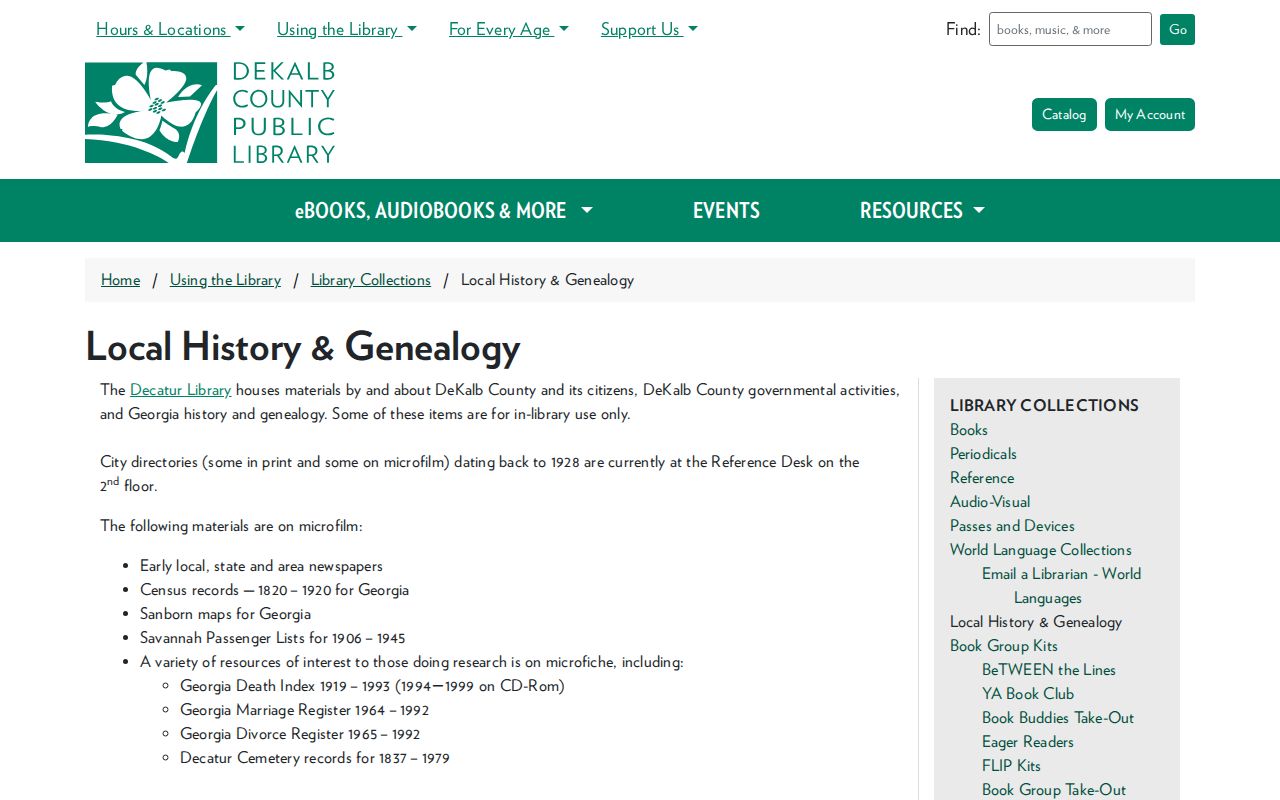
The DeKalb Library local-history and genealogy collection pairs city directories with sources that test an entry. Georgia census microfilm covers 1820 through 1920. Death indexes cover 1919 through 1993 on microfiche and 1994 through 1999 on CD. Marriage registers span 1964 through 1992, divorce registers 1965 through 1992, and Decatur Cemetery records cover 1837 through 1979.
Sanborn fire-insurance maps add structure, use, and street context, though exact Tucker sheets were not itemized and fragile holdings may require in-person use. Start with the city directory volume, copy the entry and its abbreviation key, then ask Reference Desk staff which companion source fits the year and event.
The library collection page is visible below.
Tucker City Directories Over Time
Tucker was a named railroad and post-office community from 1892, but it had no municipal government until 2016. That split explains why older Tucker city directories sit in county, Atlanta-suburban, and regional collections rather than in a century-old city archive. Publisher geography can be as important as the name printed on the cover.
| Year or period | Directory milestone |
|---|---|
| 1928 | DeKalb Library's general city-directory holdings begin. |
| 1939 | The sole DeKalb directory gives a countywide snapshot. |
| Through 1956 | Atlanta city and suburban material shared volumes. |
| 1970-1976 | Five confirmed Tucker/Stone Mountain editions survive. |
| About 1991 | Publication of the broader directory line ceased. |
The timeline is not a promise of annual coverage. The History Center warns that its runs are incomplete and gaps may be unmarked.
Read a Tucker Directory Entry
A city directory entry compresses several facts into one line. Always photograph or copy the volume's abbreviation page first. The same letter can mean residence, rooms, boards, or another publisher-specific term, and the archive cautions against guessing. Record punctuation and symbols exactly before interpreting them.
| Name | Surname, given name or initial, and sometimes spouse in parentheses |
|---|---|
| Work | Occupation and sometimes employer |
| Residence | House number, street, and a publisher-defined marker |
| Status mark | Possible homeowner or householder symbol, checked against the key |
| Family clue | A widow notation or spouse name that can lead to another record |
- Criss-cross directory
- A street-and-number arrangement that reverses the usual surname order.
- Householder index
- A list centered on the person recorded as responsible for a household, not a full occupant roll.
- Abbreviation key
- The publisher's legend for short forms and symbols in that edition.
Business and institutional entries may name officers or proprietors. A “removed” or “widow” note is a lead, not a full life event. Check the next volume, an obituary index, or a deed before deciding what changed.
Reverse Tucker City Directory Searches
The reverse section rearranges entries by street name and house number. It is useful when the address is known but the household name is not, and it can show adjacent listed households from the same publication cycle. Read the address sequence on both sides of the target, then turn back to the alphabetical section for fuller entries.
A reverse directory is dated evidence. Publication lag, omitted subscribers, multi-unit formatting, and unlisted people leave gaps. For modern owner and parcel facts, shift to the Tucker street directory workflow rather than forcing a historical volume to answer a current question.
Note: A reverse entry supports an address association for one edition; it does not establish legal ownership or continuous residence.
Maps Translate Old Tucker Addresses
Tucker's city GIS offers an unusual bridge from an old place reference to modern geography. Tucker Nostalgia overlays a 1915 DeKalb map against the present map with a draggable comparison, while Timeless Tucker pins historical photographs and descriptions. The History Center also holds a 1969 Tucker plat map, 1928 topographic maps, Sanborn material, and early plat-map books.
Ten early twentieth-century plat books were digitized with the Digital Library of Georgia in 2023. Use mapped position, owner labels, roads, and subdivision lines when a street number changed. Metro address changes in 1892 and 1926 make that check especially valuable.
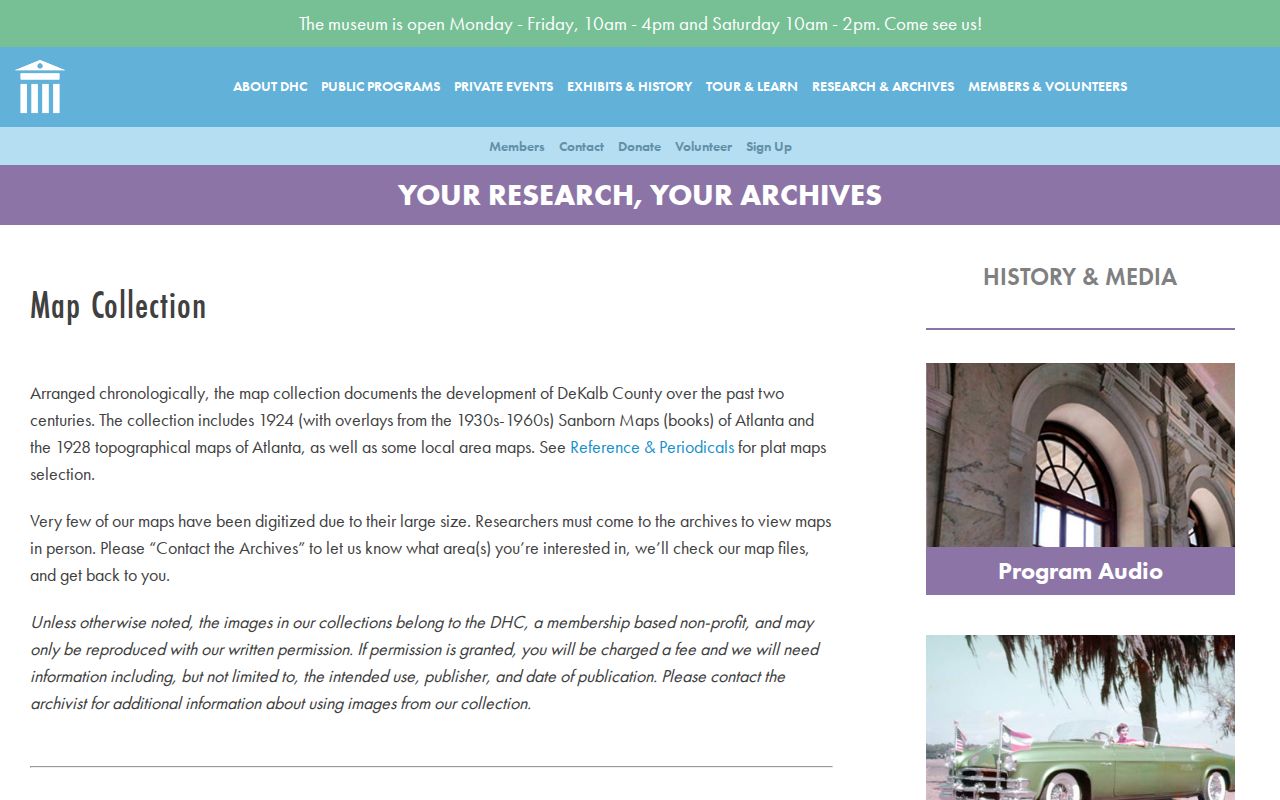
The DeKalb historical map collection shows the available map context.
Tucker Names Beyond City Directories
The DeKalb History Center special collections preserve local names that a standard city directory can miss. Twenty Tucker Elementary School scrapbooks include student and staff images, PTA summaries, programs, events, nutrition plans, and principal statements. The Tucker Time Capsule, installed at the old health center and opened in 2007, chiefly holds material from 1957 with later photographs.
Newspaper and community runs fill later gaps: Tucker Days from 1973 through 1991, Tucker Times from March 1994 through March 2007 plus later accessions, and Up Close & Personal In Tucker from 2002 into 2016 with gaps. A 2026 accession extended Tucker Times coverage through 2019 and Up Close & Personal through 2025. These are leads for clubs, moves, family events, and businesses, not substitutes for proof.
The historical periodicals inventory gives the archive's named runs and gaps.

The special-collections landing page is pictured here.

Trace Family Through Tucker Directories
City directories can bridge the years between public federal census schedules. The latest public population schedule is 1950 under the 72-year release rule, while DeKalb Library holds Georgia census microfilm through 1920. Directory entries between census dates can reveal a move, a spouse notation, an occupation change, or the first and last appearance of a household at an address.
- Choose the volume closest to a known event. Search the surname, initials, spelling variants, and any spouse name.
- Copy the exact entry and its abbreviation key. Move one available volume earlier and one later, noting every address or status change.
- Check the reverse section for the address and nearby listed households. Neighbors can help confirm that the same street segment was found.
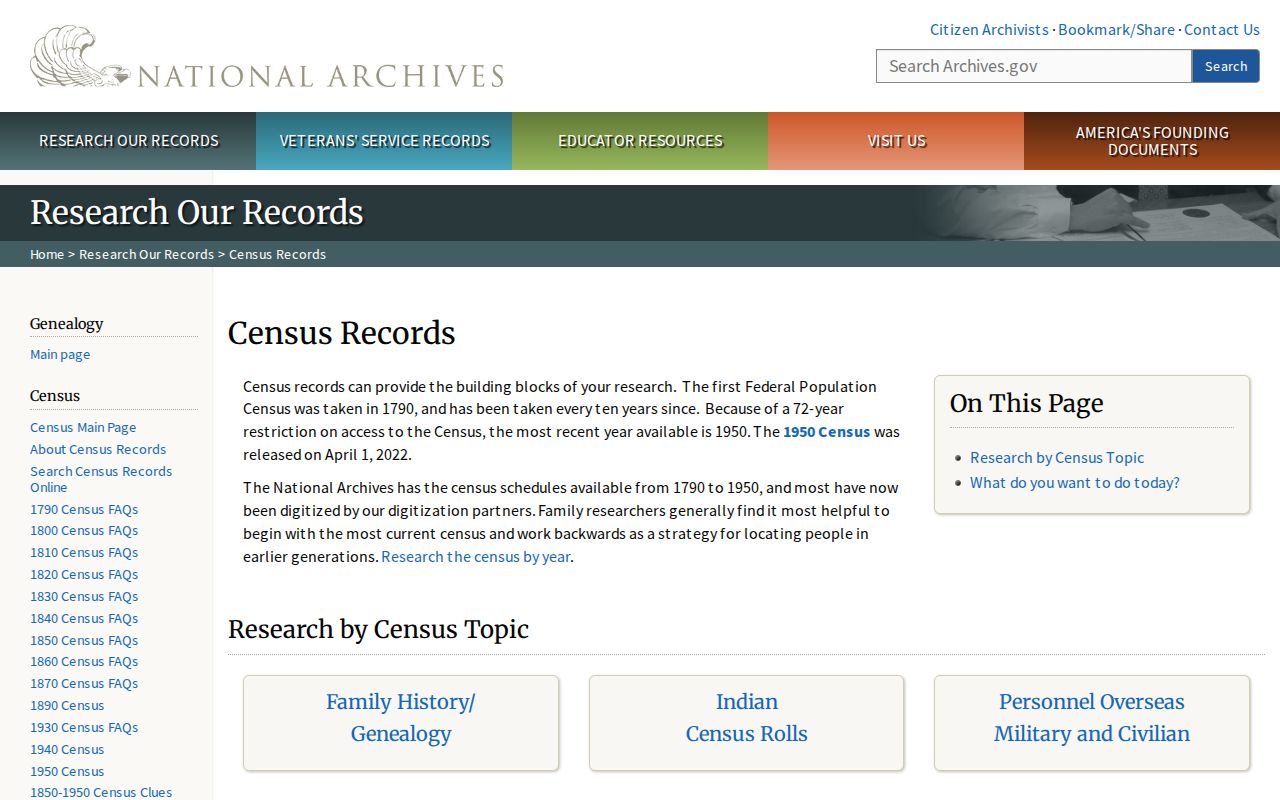
- Pair the directory evidence with a released census year through the National Archives census resources.
- Test the end of the trail against the library's death index, cemetery file, deed record, or periodical collection.
Disappearance can mean a move, death, publication gap, changed spelling, or an unlisted household. Search nearby years and companion sources before drawing a conclusion. That restraint is central to sound Tucker city directory research.
The National Archives census research page is the official starting point for released federal schedules.